Mollusks: From Tiny Snails to Giant Squid!
Amazing Fact: With over 50,000 species, mollusks are the second largest group of invertebrates on Earth! From tiny snails to giant squid, this diverse phylum includes some of the ocean’s most well-known creatures: clams, mussels, octopuses, and everything in between.
What Makes a Mollusk?
Although one might not see an obvious physical relationship between a snail and a squid, they are remarkably similar in construction. In general, mollusks have 3 body regions: a head, a visceral mass, and a “foot.”
- Head – Contains the sense organs and “brain”
- Visceral mass – Contains the internal organs
- Foot – The muscular lower part of the body in contact with the substrate
Class Gastropoda: Stomach-Footed
The class Gastropoda (meaning “stomach-foot”) contains about 70% of the Molluscan species—around 35,000! These are the familiar snails, limpets, nudibranchs and abalones.
Shelled Gastropods
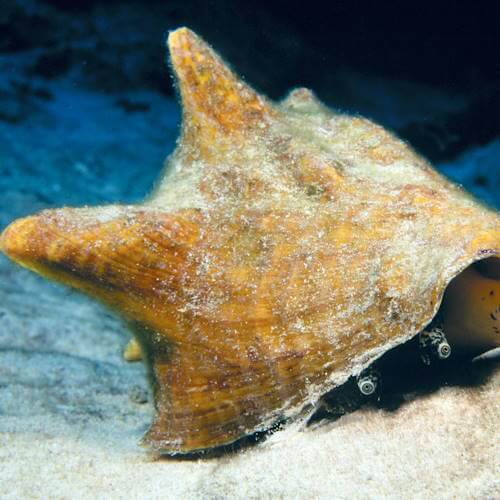
The snails, limpets and abalones have shells. The conch (pronounced “konk”) is a big snail that can weigh more than a pound! Two eyes on stalks peek out from under the shell, and the points on the shell protect it from other animals.
Shell-Less Gastropods: Nudibranchs
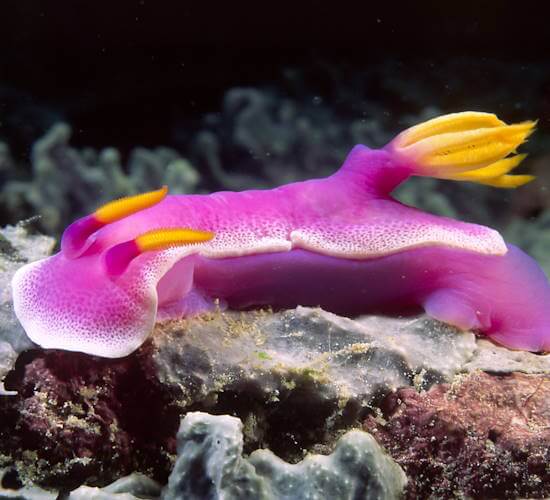
The slugs and nudibranchs do not have shells. The word “nudibranch” means naked gill. These creatures often display brilliant coloration.
Nobody is sure why some nudibranchs are so brightly colored. Some believe that the coloration is aposematic, meaning that it tells other animals “Danger! I don’t taste good!”
Mollusk Classes
Gastropoda
35,000+ species – Snails, slugs, nudibranchs, abalones
Bivalvia
15,000 species – Clams, mussels, oysters, scallops
Cephalopoda
800+ species – Squid, octopuses, cuttlefish, nautilus
Polyplacophora
1,000+ species – Chitons
Mollusk Gallery
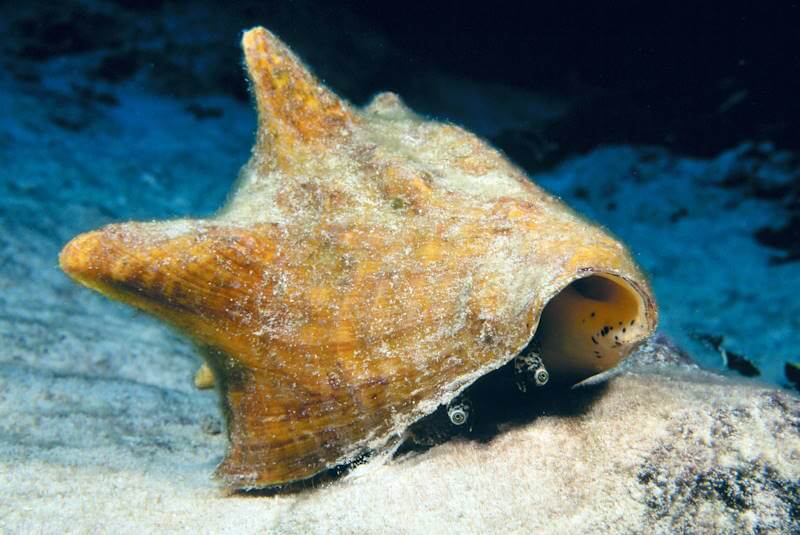
Big Gastropod: The conch (pronounced “konk”) is a big snail. There are two eyes on stalks peeking out from under the shell. The points on the shell protect it from other animals. This conch weighs more than a pound!
Big Gastropod: The conch (pronounced “konk”) is a big snail. There are two eyes on stalks peeking out from under the shell. The points on the shell protect it from other animals. This conch weighs more than a pound!
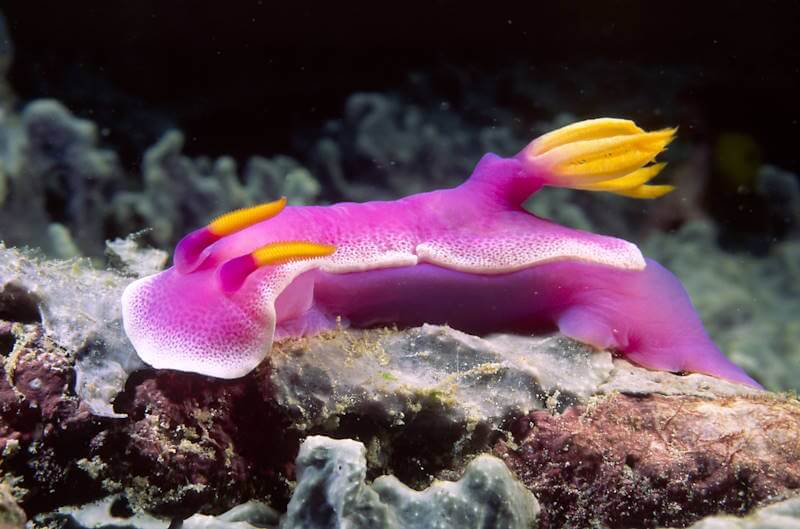
Colorful Gastropod: This is a nudibranch, basically a snail without a shell. The word “nudibranch” means naked gill. The tuft of yellow on the right side is the animal’s gill cluster. Nobody is sure why some nudibranchs are so brightly colored. Some beleive that the coloration is aposematic, meaning that it tells other animals “Danger! I don’t taste good!”
Colorful Gastropod: This is a nudibranch, basically a snail without a shell. The word “nudibranch” means naked gill. The tuft of yellow on the right side is the animal’s gill cluster. Nobody is sure why some nudibranchs are so brightly colored. Some beleive that the coloration is aposematic, meaning that it tells other animals “Danger! I don’t taste good!”
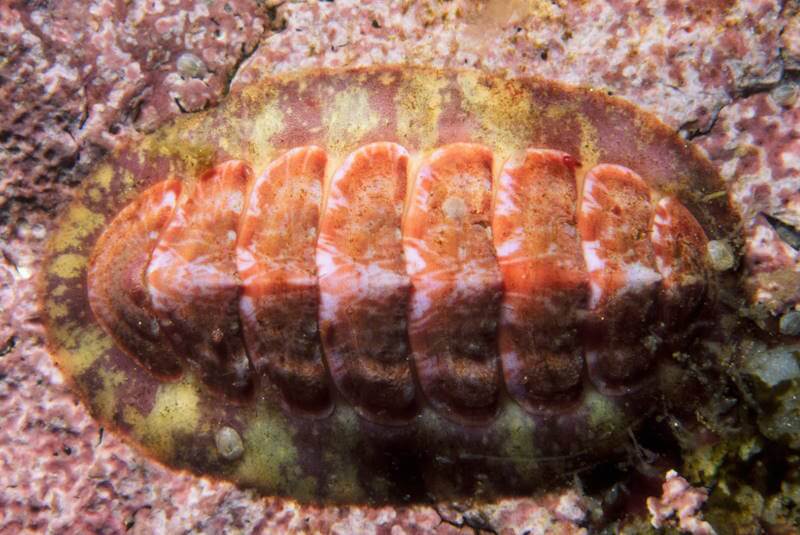
A chiton is stuck to a rock. It may not look like much, but getting it off the rock is nearly impossibel!
A chiton is stuck to a rock. It may not look like much, but getting it off the rock is nearly impossibel!
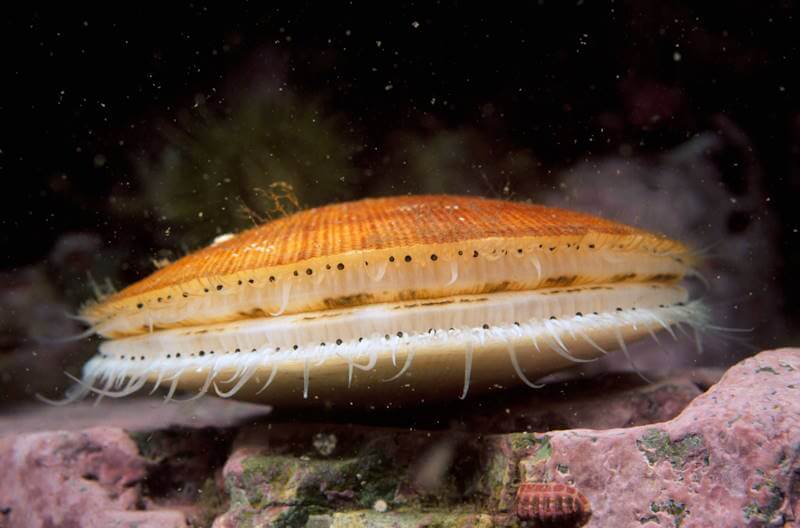
This is the scallop that most people never see. This bivalve has hundreds of tiny eyes to keep a lookout for predators (those are the tiny black dots around the opening). The animal feeds by filtering food from the water.
This is the scallop that most people never see. This bivalve has hundreds of tiny eyes to keep a lookout for predators (those are the tiny black dots around the opening). The animal feeds by filtering food from the water.
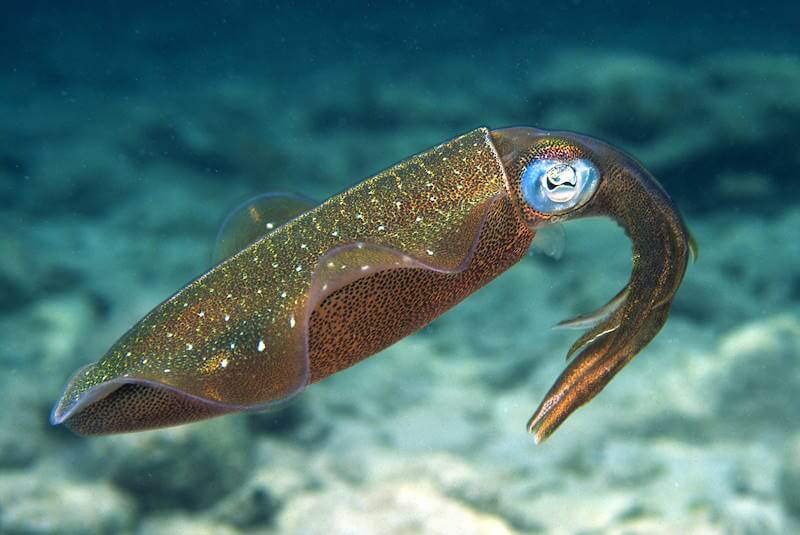
This is the Caribbean Reef squid, an animal capable of amazing color changes. Using chromatophores in its skin, the squid can go from white to blue to gold in the blink of an eye. It can jet off at high speed by squirting water though its nozzle, or it can hover in one place with its fins.
This is the Caribbean Reef squid, an animal capable of amazing color changes. Using chromatophores in its skin, the squid can go from white to blue to gold in the blink of an eye. It can jet off at high speed by squirting water though its nozzle, or it can hover in one place with its fins.
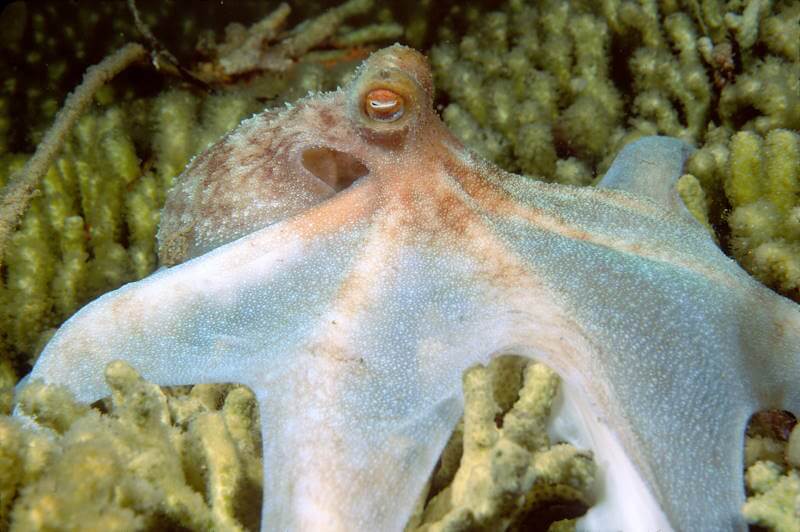
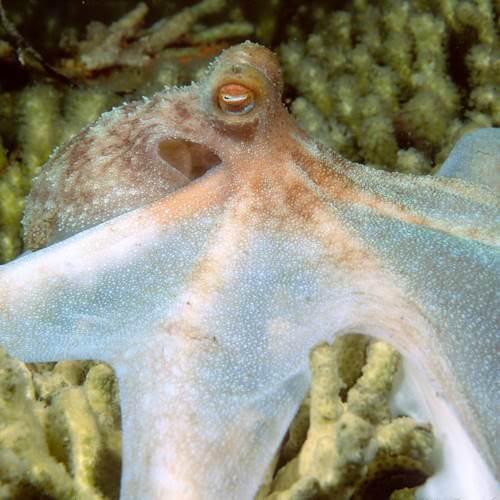
The Common Caribbean octopus on the prowl at night, looking for food.
The Common Caribbean octopus on the prowl at night, looking for food.
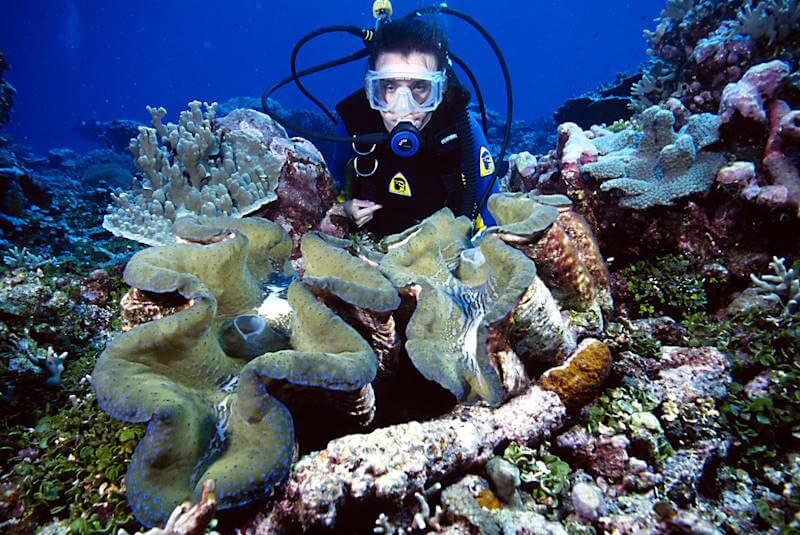
Giant Clams live in the tropical Indo-Pacific and reach several hundred pounds in weight. They have symbiotic algae in their mantle tissue that harvests the sun’s energy so they need strong sunlight to survive.
Giant Clams live in the tropical Indo-Pacific and reach several hundred pounds in weight. They have symbiotic algae in their mantle tissue that harvests the sun’s energy so they need strong sunlight to survive.
Class Polyplacophora: The Chitons
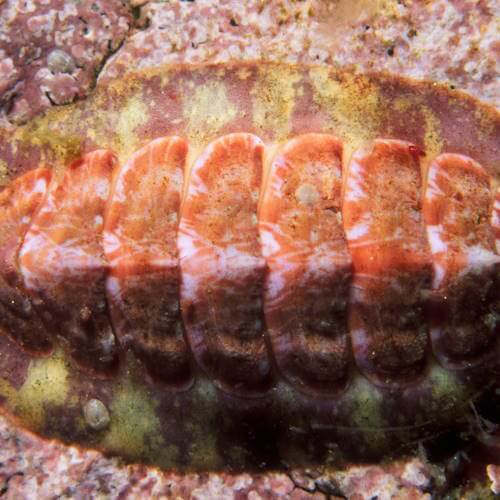
Members of the class Polyplacophora (meaning “many-plated”) are more commonly called the chitons (pronounced KIE-tuns). These creatures have eight plates and outwardly resemble the “pill-bugs” common under logs and rocks (they are not related, however).
Class Bivalvia: Two Shells
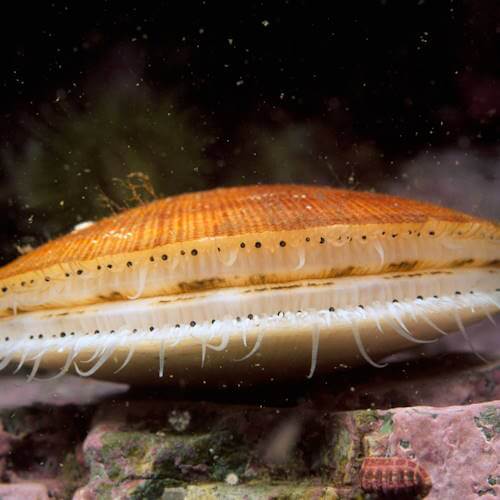
The bivalves (meaning “two-shells”) are perhaps the most well known mollusks simply because of their history as a source of food. Clams, mussels, oysters and scallops are all bivalves. There are about 15,000 known species of bivalve, with about 80% of them being marine (the rest are found in fresh water).
Class Cephalopoda: Head-Footed
Although we usually think of Mollusks as benthic (bottom dwelling), the cephalopods have taken to a nektonic (swimming), rather than benthic, existence in the ocean.
Shared Characteristics
Cephalopods do share many characteristic molluscan traits with the rest of the creatures in the phylum, such as:
- The presence of a mantle and mantle cavity
- A radula in the mouth
- A U-shaped digestive tract (useful for a creature in a conical shell, but not necessary for a Cephalopod)
Mollusk Classes
Gastropoda
35,000+ species – Snails, slugs, nudibranchs, abalones
Bivalvia
15,000 species – Clams, mussels, oysters, scallops
Cephalopoda
800+ species – Squid, octopuses, cuttlefish, nautilus
Polyplacophora
1,000+ species – Chitons
Monoplacophora
~30 species – Deep-sea limpets (living fossils)
Aplacophora
~320 species – Solenogasters, caudofoveates (worm-like mollusks)
Scaphopoda
~600 species – Tusk shells
Mollusk Gallery
Big Gastropod: The conch (pronounced “konk”) is a big snail. There are two eyes on stalks peeking out from under the shell. The points on the shell protect it from other animals. This conch weighs more than a pound!
Big Gastropod: The conch (pronounced “konk”) is a big snail. There are two eyes on stalks peeking out from under the shell. The points on the shell protect it from other animals. This conch weighs more than a pound!
Colorful Gastropod: This is a nudibranch, basically a snail without a shell. The word “nudibranch” means naked gill. The tuft of yellow on the right side is the animal’s gill cluster. Nobody is sure why some nudibranchs are so brightly colored. Some beleive that the coloration is aposematic, meaning that it tells other animals “Danger! I don’t taste good!”
Colorful Gastropod: This is a nudibranch, basically a snail without a shell. The word “nudibranch” means naked gill. The tuft of yellow on the right side is the animal’s gill cluster. Nobody is sure why some nudibranchs are so brightly colored. Some beleive that the coloration is aposematic, meaning that it tells other animals “Danger! I don’t taste good!”
A chiton is stuck to a rock. It may not look like much, but getting it off the rock is nearly impossibel!
A chiton is stuck to a rock. It may not look like much, but getting it off the rock is nearly impossibel!
This is the scallop that most people never see. This bivalve has hundreds of tiny eyes to keep a lookout for predators (those are the tiny black dots around the opening). The animal feeds by filtering food from the water.
This is the scallop that most people never see. This bivalve has hundreds of tiny eyes to keep a lookout for predators (those are the tiny black dots around the opening). The animal feeds by filtering food from the water.
This is the Caribbean Reef squid, an animal capable of amazing color changes. Using chromatophores in its skin, the squid can go from white to blue to gold in the blink of an eye. It can jet off at high speed by squirting water though its nozzle, or it can hover in one place with its fins.
This is the Caribbean Reef squid, an animal capable of amazing color changes. Using chromatophores in its skin, the squid can go from white to blue to gold in the blink of an eye. It can jet off at high speed by squirting water though its nozzle, or it can hover in one place with its fins.
The Common Caribbean octopus on the prowl at night, looking for food.
The Common Caribbean octopus on the prowl at night, looking for food.
Giant Clams live in the tropical Indo-Pacific and reach several hundred pounds in weight. They have symbiotic algae in their mantle tissue that harvests the sun’s energy so they need strong sunlight to survive.
Giant Clams live in the tropical Indo-Pacific and reach several hundred pounds in weight. They have symbiotic algae in their mantle tissue that harvests the sun’s energy so they need strong sunlight to survive.
Explore More Wonders
Sponges
Sharks
Coral Reefs
Echinoderms
Cnidarians
Sperm Whales
Chessie
Mangroves
Arthropods