Mangroves: Nurseries of the Reef!
Amazing Fact: A single teaspoon of mangrove mud contains over 10 billion bacteria! These often-overlooked coastal forests are the nurseries of the reef, providing shelter where juvenile fish grow before heading out to open waters. Mangroves are an essential part of tropical ocean ecosystems worldwide.
Living Between Land and Sea
Mangroves are plants living in the tidal coastal areas between sea and land. The term has been applied to any and all species of trees which occupy this zone of life.
All share the trait of being able to tolerate partial submersion in high salinity water, and poor oxygen content in the ground where their roots penetrate. Different kinds of mangrove trees have evolved different ways of dealing with these two limiting factors, but all true mangrove trees must deal with them to survive.
Mangroves grow only in the tropics. The richest mangrove communities occur in areas where the daytime temperature is greater than 75 degrees F (24 degrees C) and the annual rainfall exceeds 40 inches (100 centimeters).
Why Live in Salt Water?
The fact that most mangrove plants can survive in a pot watered only with fresh water indicates that mangroves don’t actually need salt to survive. Yet, they only grow in the salty waters of the ocean’s edge.
This is not because they need salt, but rather because they have evolved the means of surviving where other plants cannot, thus carving out a niche for themselves with little competition for space and nutrients from other plants.
Mangroves Facts
10 Billion Bacteria
Per teaspoon of mangrove mud!
90% Salt Filtration
Roots can filter out salt from seawater
0.25 lbs/sq ft/year
Amount of organic litter produced
Visible Salt Crystals
Can be seen on leaves after excretion
1% Annual Loss
Caribbean mangroves disappearing
Nursery Function
Critical habitat for juvenile fish
Mangroves Gallery
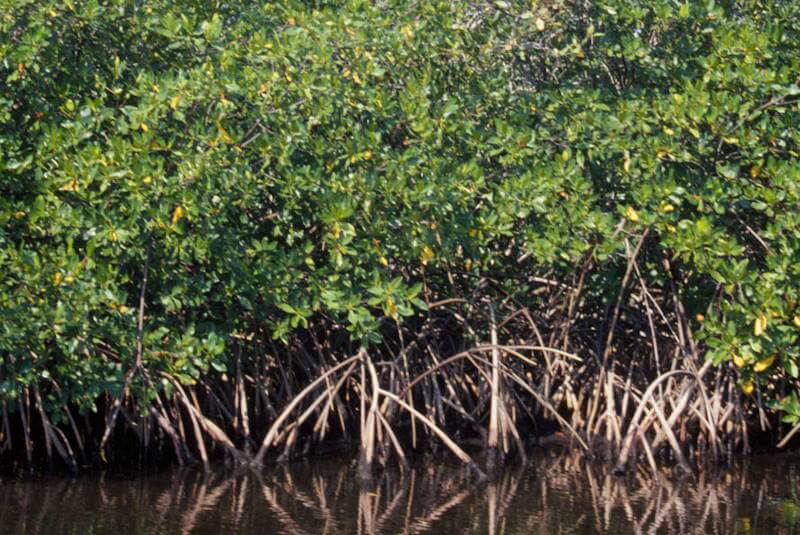
A mangrove in Utila, Honduras.
A mangrove in Utila, Honduras.
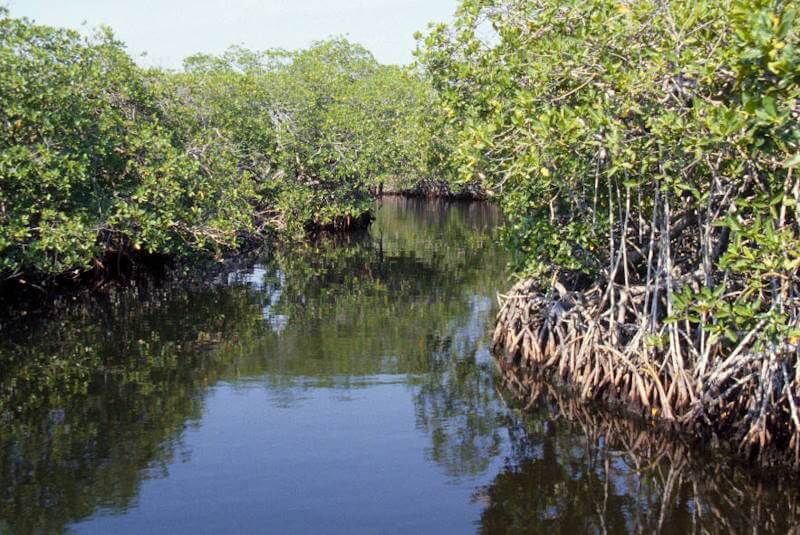
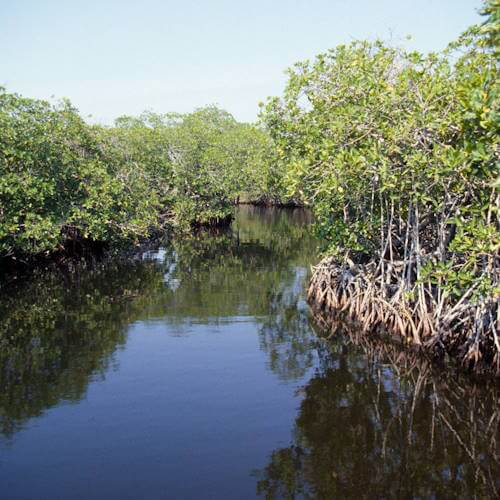
The brackish water of a mangrove.
The brackish water of a mangrove.
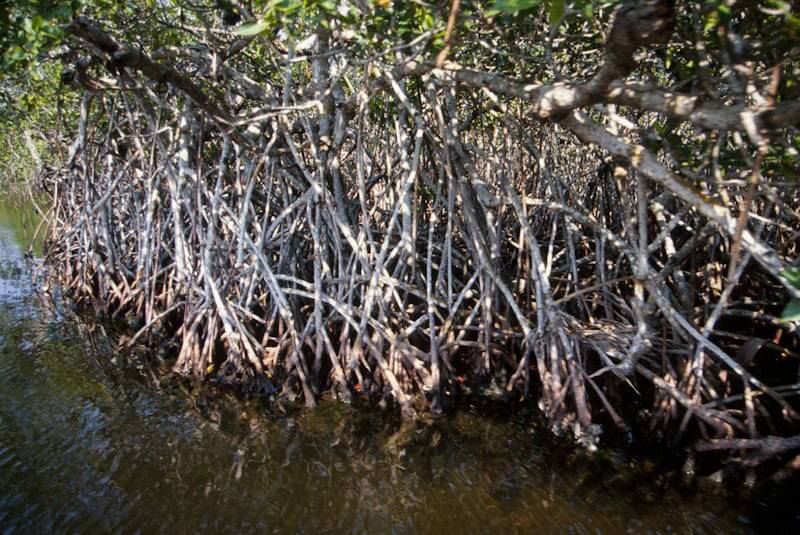
Mangrove roots.
Mangrove roots.
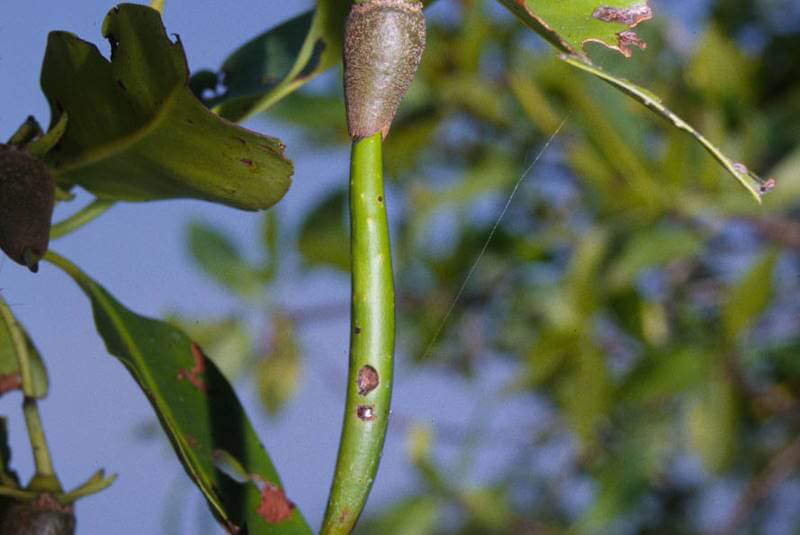
A mangrove seed, often called a “cigar.” The root is at the bottom. It will fall off the tree and float root down until it floats into the right depth water.
A mangrove seed, often called a “cigar.” The root is at the bottom. It will fall off the tree and float root down until it floats into the right depth water.
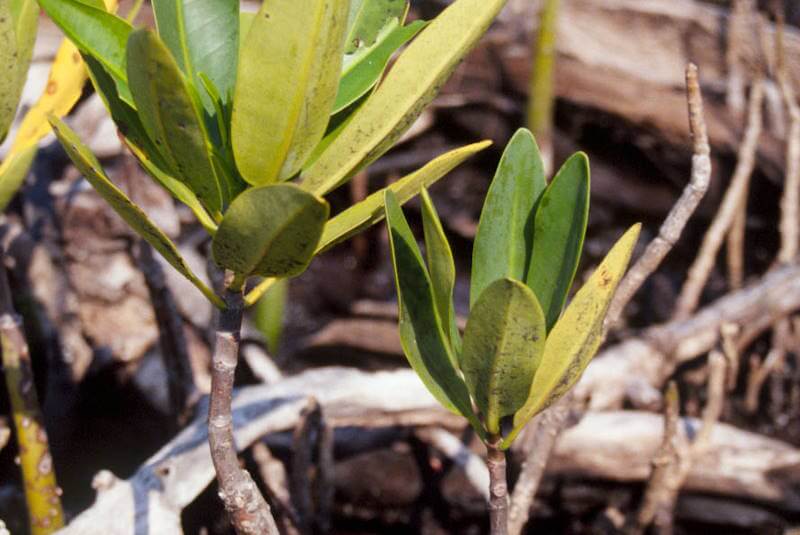
Seeds which have sprouted.
Seeds which have sprouted.
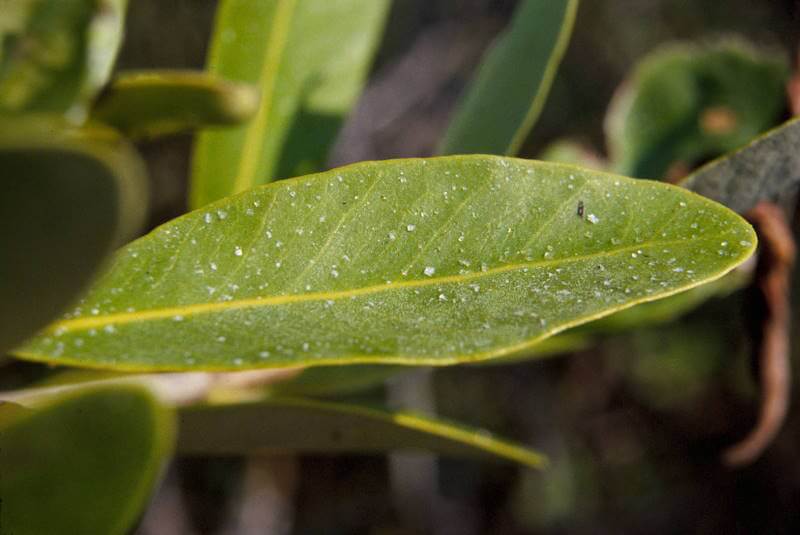
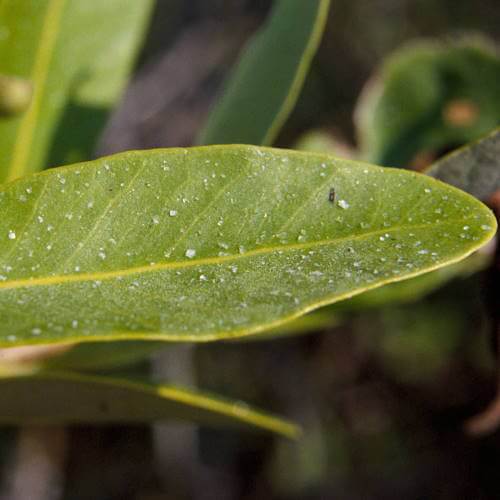
A leaf showing crystals of excreted salt.
A leaf showing crystals of excreted salt.
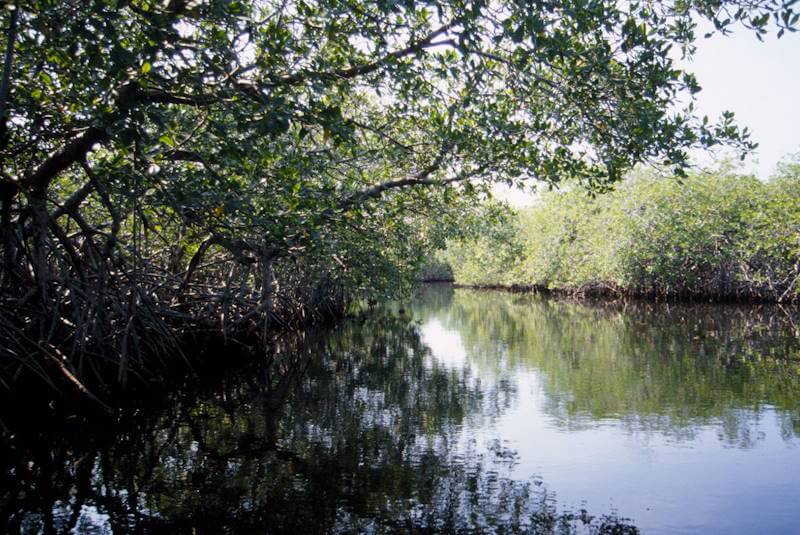
Mangroves provide valuable habitat for juvenile fish and protect shorelines from erosion.
Adapting to Salt
Salt Filtration
To deal with salt, many mangroves stop the salt from entering their tissues by filtering it out at root level. Some mangrove plants can exclude about 90% of the salt in the salt water they absorb with a special filter in the roots. But some salt still gets in.
Salt Excretion
So the next trick is to excrete the unwanted salt. Some plants do this with salt glands in their leaves. In fact, the leaves of many mangrove plants have the most efficient salt-excreting systems known.
In some species, excreted salt crystals can be seen or tasted on the leaves! Another technique concentrates the unwanted salt in bark or older leaves. The plant periodically sheds the bark and leaves, taking the salt away with it.
Nutrient Factory
Mangrove plants produce on average about a quarter of a pound of litter (bark, leaves, twigs, fruit, flowers, etc.) per square foot per year (1 kg/square meter/yr). Some of this is directly consumed by small animals, like crabs and fishes, but most of it has to be broken down further before the nutrients are available to other animals or plants.
Bacterial Powerhouse
Because of the amount of organic material to be broken down, the mud at the bottom of the mangrove forest has a very high concentration of bacteria. In fact, a typical teaspoon of mud from a mangrove has more than 10 billion bacteria in it!
The bacteria consume the litter, digesting it and increasing the amount of protein it makes available to other animals. When fishes and invertebrates feed on this waste, they produce their own waste which feeds yet other animals. The smallest remains feed plankton in the open ocean as it washes out to sea every day on the receding tide.
The tides carry a cargo of food out to sea from the mangroves every time they retreat, making the mangrove an important food and nutrient source for animals and plants on the reefs and in the open ocean.
Breathing Underwater
Since the mud in the mangrove is so thick with litter, bacteria, and the end result of lots of decomposition, it has very little oxygen. So instead of absorbing oxygen through their underground roots, like many plants, the mangrove plant has developed long roots which come up out of the water into the air before joining the trunk of the plant.
The roots have “breathing” cells above water called lenticels which draw in air.
Amazing Reproduction
Mangroves typically produce fruits or seeds that float. This makes sense for plants that live at least part of their lives in water. As the fruit or seeds are dropped, they float away on the tide, to hopefully mature elsewhere, thus spreading the population of mangroves.
Probably because mangrove plants can only thrive in a narrow range of conditions, many species have developed fascinating techniques of reproduction. While the dispersal of live, germinated seeds (known as vivipary) is very rare in most plants, many species of mangrove plants utilize this technique.
Refuge & Nursery
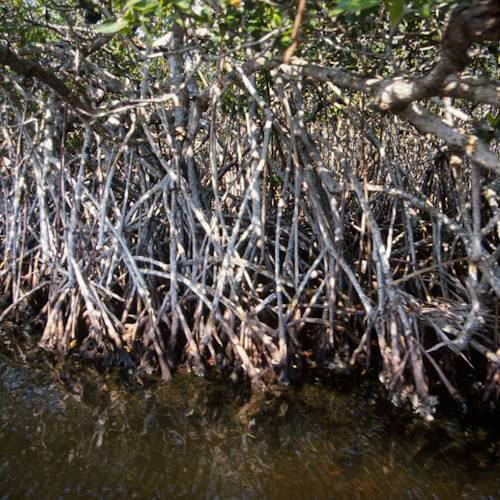
Perhaps the most important contribution to the ecosystem made by mangroves is as a refuge. The tangled maze of roots in the mangrove forest creates a confusing shallow water labyrinth.
Conservation Crisis
Alarming Loss Rate
Currently, the Caribbean is losing mangroves at a rate of about one percent per year. Most of the loss is on mainlands (like Venezuela, Colombia and Panama) rather than islands, although the Bahamas have lost nearly half their mangroves in the past ten years.
People sometimes lament the loss of pretty mangroves, but rarely do they realize just how hard the destruction impacts the reef and the shoreline. Loss of mangroves effects not just mangrove fishing, but productivity on the reefs as well.
Mangroves Facts
10 Billion Bacteria
Per teaspoon of mangrove mud!
90% Salt Filtration
Roots can filter out salt from seawater
0.25 lbs/sq ft/year
Amount of organic litter produced
Visible Salt Crystals
Can be seen on leaves after excretion
1% Annual Loss
Caribbean mangroves disappearing
Nursery Function
Critical habitat for juvenile fish
Mangroves Gallery
A mangrove in Utila, Honduras.
A mangrove in Utila, Honduras.
The brackish water of a mangrove.
The brackish water of a mangrove.
Mangrove roots.
Mangrove roots.
A mangrove seed, often called a “cigar.” The root is at the bottom. It will fall off the tree and float root down until it floats into the right depth water.
A mangrove seed, often called a “cigar.” The root is at the bottom. It will fall off the tree and float root down until it floats into the right depth water.
Seeds which have sprouted.
Seeds which have sprouted.
A leaf showing crystals of excreted salt.
A leaf showing crystals of excreted salt.
Mangroves provide valuable habitat for juvenile fish and protect shorelines from erosion.
Explore More Wonders
Sponges
Sharks
Coral Reefs
Echinoderms
Cnidarians
Mollusks
Sperm Whales
Chessie
Arthropods