
Sperm Whales: The Deep Divers of the Ocean!
Amazing Fact: Sperm whales can hold their breath for over an hour and dive nearly 4,000 feet deep to hunt for giant squid and other prey! These deep divers are the largest toothed whales on Earth and have the biggest brain of any animal that has ever lived.
Masters of the Deep
Down in the depths, where there is no light, Sperm whales hunt using echolocation. The whale produces a series of loud clicks which travel through the water and bounce off objects. The reflected sound bounces back to the whale, which interprets the echo.
Using this technique, many kinds of whales and dolphins can “see” in complete darkness. Sperm whales can most likely determine the size, direction and distance of prey, which helps them hunt deep below where there is no light.
The only problem with echolocation is that it can also give away the presence of the whale if the prey hears it. Lucky for Sperm whales that giant squid can’t hear.

The Blow: Hard to Spot
Seeing a Sperm whale on the water can be tough because the spout is not very high. Unlike other whales that have a tall, vertical blow, the Sperm whale’s blow comes out at an angle forward and to the left, making it distinctive but harder to spot from a distance.
Sperm Whale Facts
Biggest Brain
Largest brain of any animal ever
3,900+ Feet
Documented dive depth (possibly 10,000+!)
60+ Minutes
Can hold breath over an hour
550 ft/min
Astonishing descent speed
440 lbs
40-foot giant squid found whole in stomach
Not Endangered
Only great whale with stable population (~1 million)
Sperm Whale Gallery
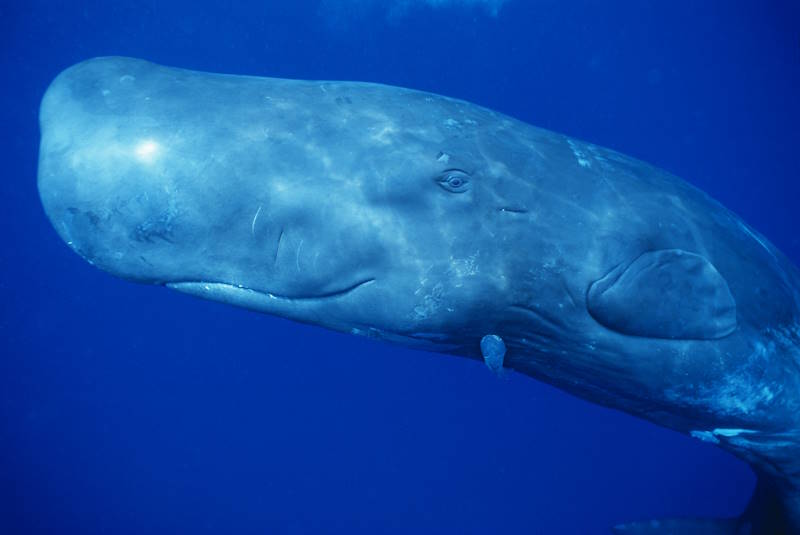
A Sperm whale calf investigating the camera!
A Sperm whale calf investigating the camera!
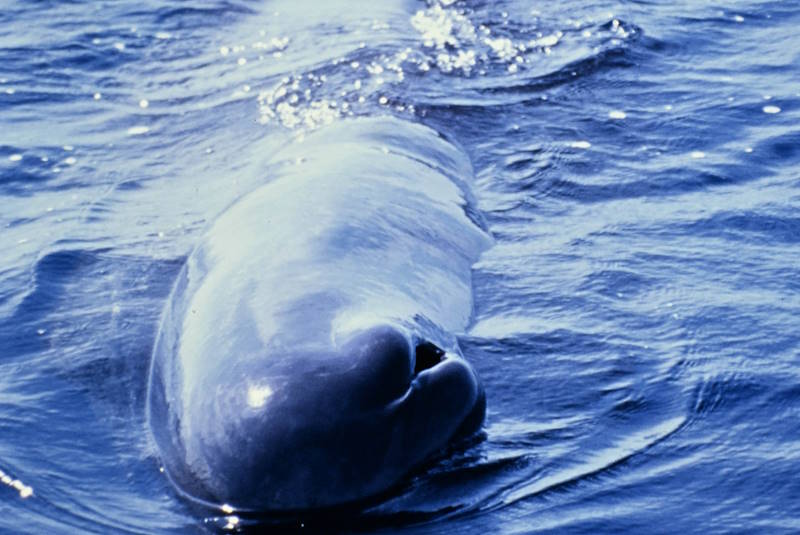
The Sperm Whale’s blow hole is at an angle on the left side of its head. This causes its blow to shoot to the left. You can see in this photo how the blowhole looks like a pair of lips, and it works like one too. The whale closes the blowhole when it dives to keep the water out.
The Sperm Whale’s blow hole is at an angle on the left side of its head. This causes its blow to shoot to the left. You can see in this photo how the blowhole looks like a pair of lips, and it works like one too. The whale closes the blowhole when it dives to keep the water out.
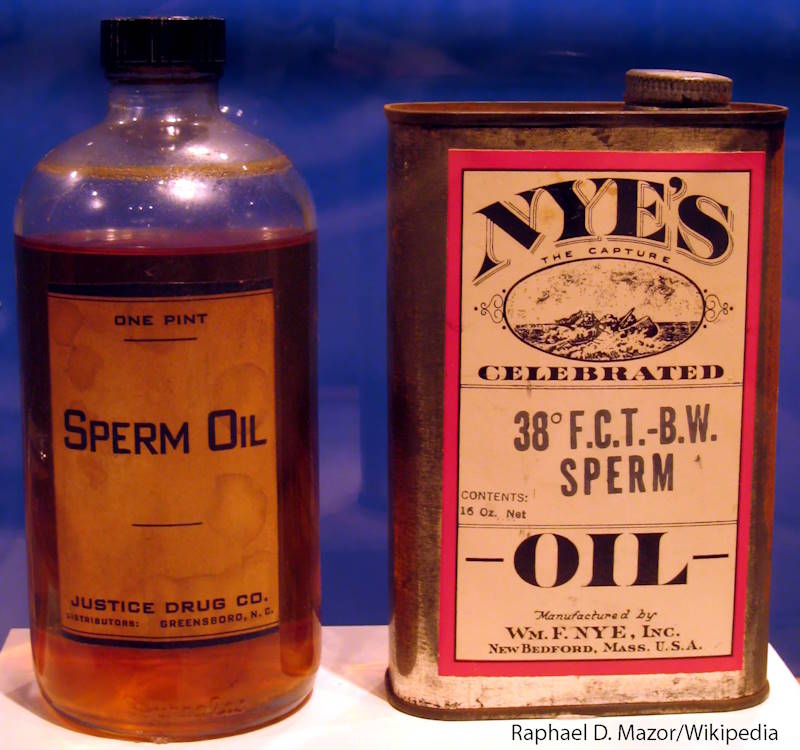
These products were made from Sperm whales back in the whaling days. Sperm whale oil was considered the finest lubricating oil on Earth.
These products were made from Sperm whales back in the whaling days. Sperm whale oil was considered the finest lubricating oil on Earth.
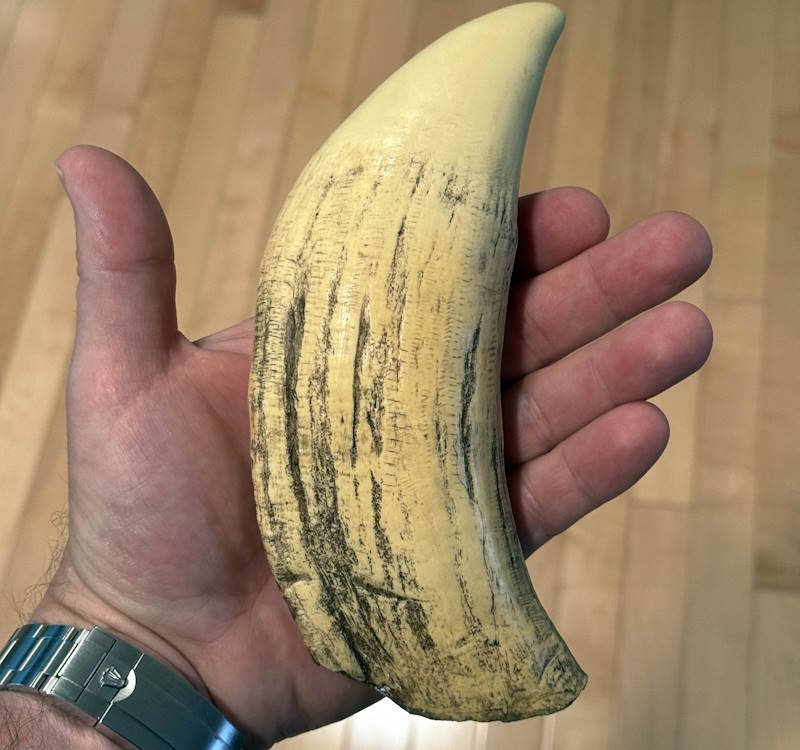
The tooth of a Sperm whale can get even bigger than this. A big one can be 8 inches long!
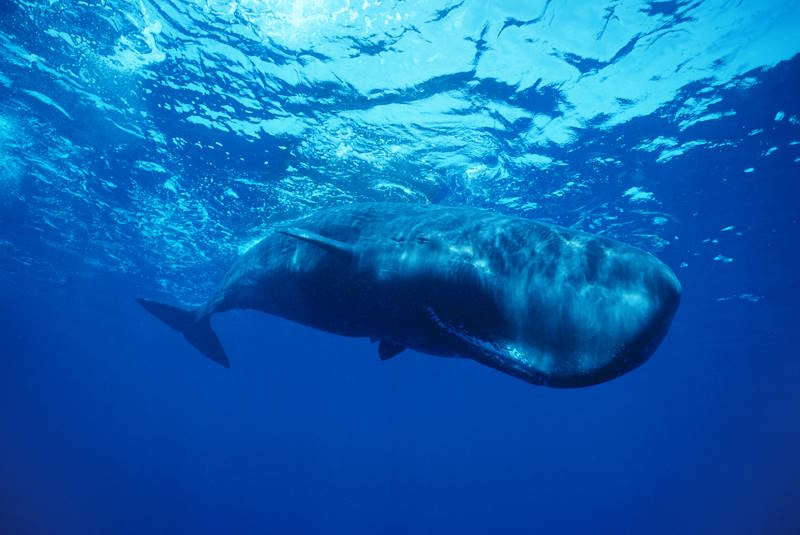
A Sperm whale playing at the surface of the Caribbean.
A Sperm whale playing at the surface of the Caribbean.
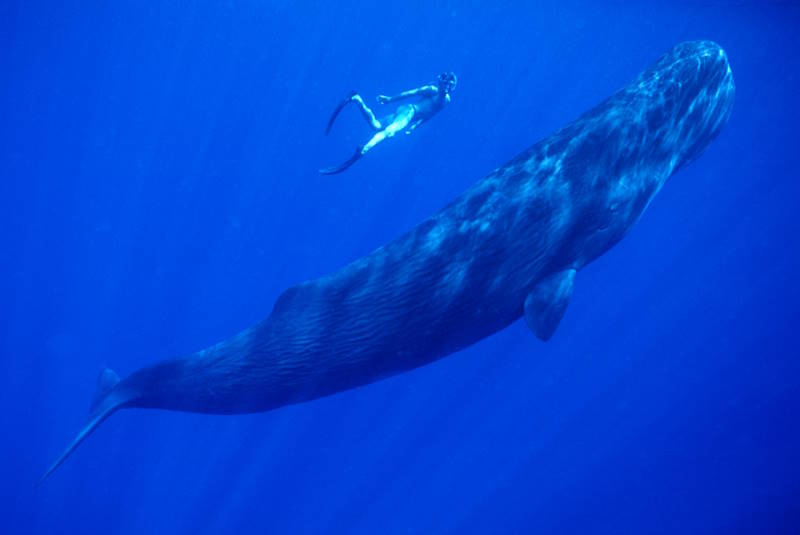
A Sperm whale and human
A Sperm whale and human
The Mysterious Spermaceti Organ

The Sperm whale gets its name from the spermaceti organ which fills most of its huge head. In the 18th and 19th centuries, New England whalers sought out the Sperm whale for the valuable spermaceti oil, which makes an exceptionally fine lubricant.
Nobody is absolutely sure what the spermaceti organ actually does for the whale, but there are two prevalent theories:
Incredible Diving Abilities
Deep Diving Champions
Because of an uncanny ability to efficiently store oxygen in their blood and muscles, adult Sperm whales can stay submerged well over an hour without taking a breath!
They have been tracked by sonar diving to depths of 3,900 feet. However, one Sperm whale caught by a whaling ship in water 10,000 feet deep had a bottom-dwelling shark in its stomach, leading researchers to believe that the Sperm whale can dive a lot deeper than seems possible.
Just as amazing is how fast the whales may reach that depth. In one study, a Sperm whale descended at an astonishing 550 feet per minute!
Teeth & Feeding
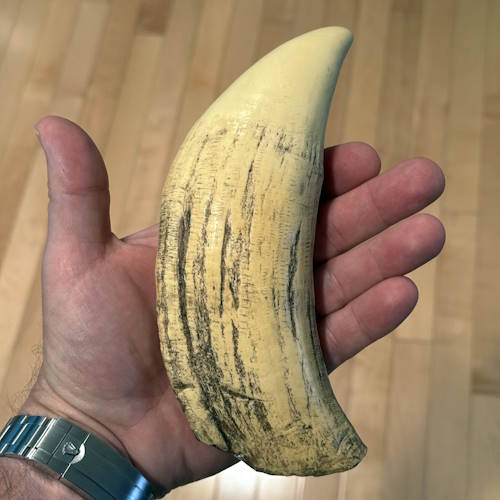
The Sperm whale has a mouth full of conical teeth located only in the lower jaw. They fit into sockets in the roof of the mouth. They look pretty mean, but probably aren’t all that important in feeding.
Ambergris: The Whale’s Treasure
Giant squid, like all squid, have sharp beaks, not unlike those of a parrot. They use them for biting into the fish and invertebrates that they eat. In the stomach of a Sperm whale, those beaks can accumulate. In fact, Sperm whales are often found to have thousands of the beaks in their stomachs!
But the sharp beaks irritate the stomach lining. As a reaction to the irritation of all the squid beaks, the whale produces in its intestines a cholesterol derivative which has come to be called ambergris.
Conservation Status
A Hopeful Story
During the 1970’s, the Save The Whale movement brought the plight of whales to international recognition. Many people now believe that whales are “saved.” This couldn’t be further from the truth. All around the world, whaling still exists. Many countries continue to hunt whales, in spite of international treaties to protect them.
Sperm Whale Facts
Biggest Brain
Largest brain of any animal ever
3,900+ Feet
Documented dive depth (possibly 10,000+!)
60+ Minutes
Can hold breath over an hour
550 ft/min
Astonishing descent speed
440 lbs
40-foot giant squid found whole in stomach
Not Endangered
Only great whale with stable population (~1 million)
Sperm Whale Gallery
A Sperm whale calf investigating the camera!
A Sperm whale calf investigating the camera!
The Sperm Whale’s blow hole is at an angle on the left side of its head. This causes its blow to shoot to the left. You can see in this photo how the blowhole looks like a pair of lips, and it works like one too. The whale closes the blowhole when it dives to keep the water out.
The Sperm Whale’s blow hole is at an angle on the left side of its head. This causes its blow to shoot to the left. You can see in this photo how the blowhole looks like a pair of lips, and it works like one too. The whale closes the blowhole when it dives to keep the water out.
These products were made from Sperm whales back in the whaling days. Sperm whale oil was considered the finest lubricating oil on Earth.
These products were made from Sperm whales back in the whaling days. Sperm whale oil was considered the finest lubricating oil on Earth.
The tooth of a Sperm whale can get even bigger than this. A big one can be 8 inches long!
A Sperm whale playing at the surface of the Caribbean.
A Sperm whale playing at the surface of the Caribbean.
A Sperm whale and human
A Sperm whale and human
Explore More Wonders
Sponges
Sharks
Coral Reefs
Echinoderms
Cnidarians
Mollusks
Chessie
Mangroves
Arthropods